2026 Top Car Battery Types for Global Buyers
Choosing the right car battery in 2026 requires more than comparing prices and cold-cranking amps. Global buyers face different climates, driving patterns, vehicle electronics, and service networks. A battery that performs well in Germany may struggle in tropical Southeast Asia or high-altitude Latin America.
The International Energy Agency reported that global electric car sales exceeded 17 million units in 2024. Electric vehicles now influence battery technology, supply chains, and consumer expectations. BloombergNEF also reported that average lithium-ion battery pack prices fell to about $115 per kilowatt-hour in 2024. However, pack prices do not equal replacement costs. Installation, software compatibility, shipping, and recycling can change the final bill.
Lead-acid batteries remain widely used for conventional vehicles. Flooded, EFB, and AGM designs serve different start-stop requirements. AGM batteries suit vehicles with heavier electrical loads and regenerative braking. Lithium-ion batteries offer lower weight and strong energy density. Yet they need proper battery-management systems and trained servicing. Sodium-ion technology is gaining attention, although its automotive replacement market remains limited.
Real-world inspection still matters.
A careful Car Battery Purchase should match the vehicle manufacturer’s specifications, terminal layout, reserve capacity, and local warranty support. Buyers should also check production dates, because batteries lose useful life during storage. This guide compares major battery types for global buyers in 2026. It uses evidence from the IEA, BloombergNEF, Battery Council International, and automotive service practices. The evidence is useful, but not perfect. Regional data remains uneven, and marketing claims sometimes move faster than independent testing.
Define the 12 V Baseline: Six 2.1 V Lead-Acid Cells per Battery
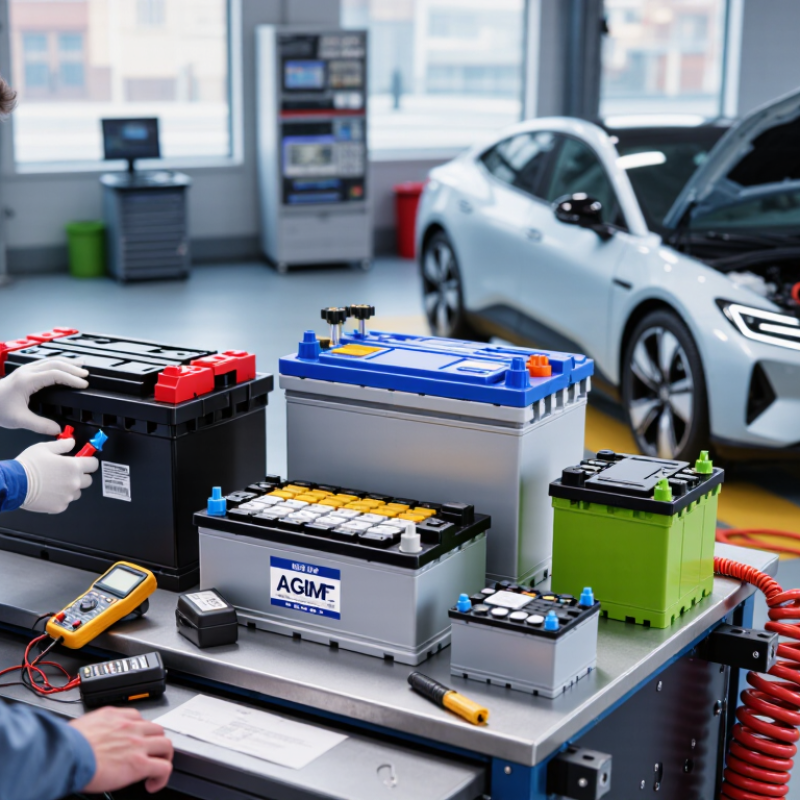
A 12 V lead-acid battery is built from six cells connected in series. Each cell has a nominal voltage near 2.1 V when fully charged. Together, they provide about 12.6 V at rest, not exactly 12 V. The 12 V label describes the system class, while the six-cell structure explains its working baseline.
This detail matters when comparing battery types in 2026. Flooded, AGM, and gel batteries still follow this six-cell design, although their separators and electrolyte control differ. A healthy battery may show around 12.6 to 12.8 V after resting. During starting, its voltage should not collapse sharply. Temperature changes the reading, so testing a cold battery beside a warm one can mislead buyers.
Voltage alone is not enough.
I have seen batteries display normal resting voltage but fail under a heavy cranking load. Internal plate damage, sulfation, or one weak cell can remain hidden. A proper check should include open-circuit voltage, load performance, charging voltage, and visible case condition. Check the terminals too. Corrosion adds resistance and may imitate a weak battery.
The six-cell design is simple, but battery behavior is not. A vehicle’s charging system must match the battery’s construction and operating temperature. Buyers should also confirm the correct size, polarity, capacity, and starting-current rating. Small differences matter. A rushed voltage check can create false confidence.
Compare Flooded, EFB, and AGM Using 60–80 Ah and 600–800 A Ratings
For global buyers, 60–80 Ah and 600–800 A ratings create a practical comparison range. Ah indicates stored capacity, while A usually refers to cold-cranking performance. These numbers are not interchangeable. Testing standards, temperature, and battery design can change the result. Check the vehicle manual and the battery label.
A flooded battery often suits conventional vehicles with moderate electrical demand. It can deliver reliable starting power at a lower purchase cost. However, repeated short trips may reduce its service life. An EFB battery adds stronger cycling ability and better charge acceptance. It fits many vehicles with basic stop-start systems. In workshop inspections, EFB batteries often handle urban traffic better than standard flooded types. That shortcut failed.
AGM technology usually provides the strongest cycling performance within this range. Its low internal resistance supports heavy electrical loads and frequent engine restarts. A 70 Ah AGM battery rated at 700 A may suit advanced stop-start vehicles, heated seats, and many control modules. It usually costs more and requires correct charging control. Overcharging can damage it. Fit matters. Buyers should verify case size, terminal position, polarity, reserve capacity, and charging compatibility. A higher rating is not automatically safer or better. Battery choice should match the vehicle’s electrical system, climate, driving pattern, and approved replacement type. My early assumption that maximum cranking power solved every starting problem was wrong. Poor connections and weak charging systems can defeat any battery.
2026 Top Car Battery Types for Global Buyers
Representative mid-range comparison of 12 V flooded, EFB, and AGM starter batteries within the common 60–80 Ah and 600–800 A market band. Actual specifications vary by battery size, vehicle application, temperature, and manufacturer.
Reading the chart: Capacity indicates stored electrical charge, while cold cranking current (CCA) indicates the battery’s starting-current capability under a standardized cold-test condition. AGM batteries commonly provide the highest starting-current performance in this comparison, while EFB is positioned between conventional flooded and AGM designs.
Match Start-Stop Vehicles: EFB for Standard Use, AGM for Heavy Cycling
2026 Top Car Battery Types for Global Buyers
Start-stop vehicles need more than a battery that simply starts the engine. The International Energy Agency reported over 17 million electric-car sales in 2024, yet millions of combustion and hybrid vehicles still use 12-volt batteries. For these vehicles, matching the battery to driving conditions remains essential.
EFB suits standard start-stop use. It handles repeated engine restarts and offers stronger charge acceptance than conventional flooded batteries. A practical example is a commuter car restarting at traffic lights several times during a short city trip.
AGM is better for heavy cycling. Its electrolyte is held in glass-mat separators, reducing movement and improving vibration resistance. EUROBAT’s automotive battery guidance identifies AGM technology for vehicles with higher electrical demand, frequent cycling, and regenerative braking.
That includes vehicles with heated seats, electric tailgates, advanced driver-assistance systems, or long idle periods. AGM also performs more consistently when the battery faces deep discharge and rapid recharge events.
Check the label.
The choice is not perfectly clean. Some vehicles accept both technologies, while others require battery-management-system registration after replacement. A 70 Ah EFB is not automatically equivalent to a 70 Ah AGM. Capacity, cold-cranking performance, dimensions, terminal layout, and charging strategy must all match.
SAE and EN battery testing procedures measure different traits, including starting power, reserve capacity, and endurance. Therefore, catalogue matching alone can mislead buyers. Measure twice. Verify the vehicle manual, charging voltage, and original battery technology before ordering.
Choose LFP or NMC by 2,000+ Cycles, Safety, Range, and Energy Density
2026 Top Car Battery Types for Global Buyers
Choosing LFP or NMC depends on more than driving range. LFP cells commonly exceed 2,000 charge cycles in controlled laboratory tests. Their iron-phosphate chemistry also offers stronger thermal stability. That matters in hot cities, heavy traffic, and frequent fast charging. The International Energy Agency reported that LFP batteries represented nearly half of the global electric-car battery market in 2024. Their lower material cost is another practical advantage.
NMC batteries usually provide higher energy density. This allows longer range from a similarly sized pack. It also helps reduce vehicle weight. The U.S. Department of Energy identifies typical commercial lithium-ion cells across a broad energy-density range, depending on chemistry and design. In real vehicles, NMC can suit long-distance drivers who dislike frequent charging. However, higher energy density does not automatically mean better ownership. Thermal management, charging habits, climate, and software strongly affect service life.
Look beyond the headline cycle number. A 2,000-cycle rating may assume moderate temperatures and carefully controlled charging. Real roads are messier. BloombergNEF’s battery research shows continuing improvements in cost and cell performance, but published figures are not perfectly comparable. Buyers should request usable capacity, warranty conditions, cold-weather range, and independent safety testing. For daily commuting and long ownership, LFP may offer calmer, lower-cost durability. For maximum range and compact packaging, NMC remains attractive. The right answer is vehicle-specific, not universal.