
What Are the Top Mining Truck Brands Worldwide?

Choosing the world’s leading Mining Truck brands requires more than comparing payload figures. Reliability, fuel efficiency, autonomous operation, maintenance support, and site conditions also matter. Caterpillar’s 797F carries up to 400 short tons, while Komatsu’s 980E offers a payload of approximately 363 tonnes. BelAZ’s 75710 reaches about 450 tonnes. These figures show scale, but they do not tell the whole story.

Industry reports add important context. The International Energy Agency’s Global Critical Minerals Outlook 2024 highlights growing demand for minerals supporting electrification and clean-energy technologies. That demand will increase pressure on mines to move more material with fewer emissions and safer operating practices. The ICMM’s safety reports also emphasize stronger risk management and responsible production across the mining sector. Technology alone is not enough.

ICMM CEO Ro Dhawan has stated, “Mining can and must be a force for good.” His words offer a useful test for every Mining Truck manufacturer. Does the equipment reduce exposure to danger? Can it perform reliably in dust, heat, steep haul roads, and freezing conditions? Does its digital system produce useful data, or simply add complexity?

This guide compares major brands through those practical questions. It considers Caterpillar, Komatsu, Hitachi, Liebherr, Volvo, and BelAZ. No ranking is perfect. A truck that excels in a Western Australian iron-ore mine may struggle in a high-altitude copper operation. Real performance depends on operators, maintenance teams, terrain, and disciplined fleet management. Those details are easy to overlook. They should not be.
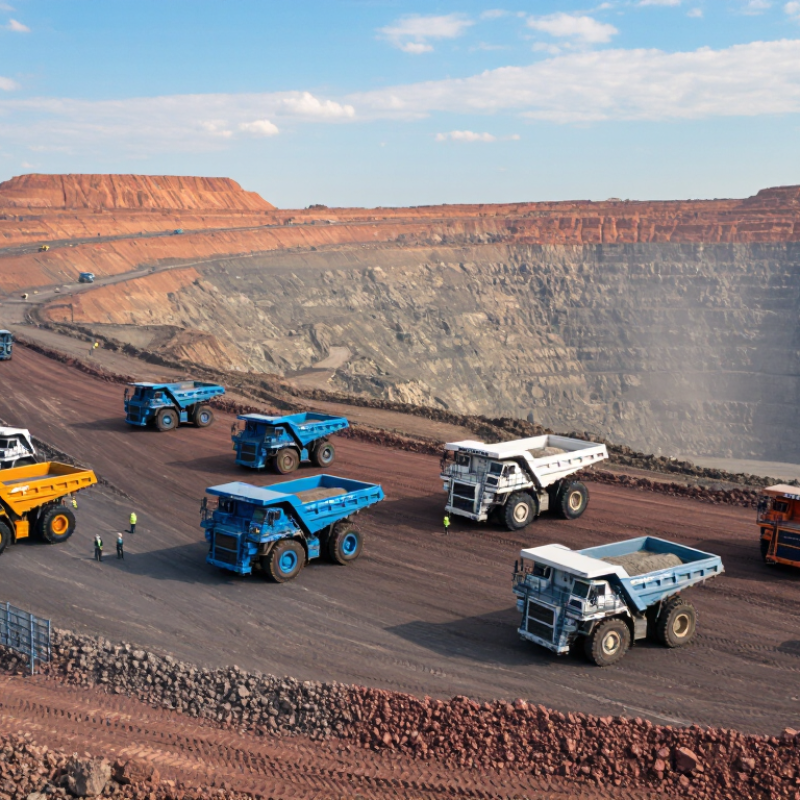
What Are the Top Mining Truck Brands Worldwide?

Mining Trucks: Definition, Purpose, and Key Operating Features

Mining trucks are heavy-duty vehicles designed to move blasted rock, ore, and waste across mine sites. Unlike road trucks, they operate on private haul roads with steep grades, loose surfaces, and sharp turns. Their large frames, high ground clearance, and reinforced beds support continuous loading cycles. Payload capacity may range from several dozen to several hundred tonnes.

Their main purpose is simple: move material safely and efficiently between loading areas, crushers, stockpiles, and dumping zones. Operating performance depends on more than engine power. Tire condition, road drainage, dust control, and loading balance directly affect productivity. A poorly graded haul road can increase vibration, fuel use, and stopping distance. Small delays become expensive.

Key features include powerful drivetrains, retarding systems, automatic monitoring, and operator visibility. Retarders help control speed on long descents, while service brakes provide final stopping power. Onboard sensors can track payload, temperature, tire pressure, and mechanical warnings. These systems support maintenance decisions, but they are not perfect. Sensor readings still need trained human judgment. In daily inspections, a loose handrail, damaged mirror, or unusual tire mark may reveal a problem before software does. Conditions also change quickly after rain, freezing weather, or blasting. Careful operators adjust speed and routes instead of trusting standard settings blindly.

Leading Mining Truck Brands and Their Signature Models

Leading Mining Truck Brands and Their Signature Models

The strongest mining truck manufacturers compete through payload, uptime, and site-specific engineering. Their signature models usually fall into three classes: ultra-class haulers above 350 metric tons, 400-short-ton rigid trucks, and flexible units near 300 tons. Technical sheets show clear differences. One ultra-class model carries about 450 metric tons, while a 400-short-ton electric-drive truck targets deep open-pit operations. A 363-ton truck focuses on modular maintenance, and a 296-ton AC-drive model suits mines with tighter haul roads.

Market data supports this equipment hierarchy. Off-Highway Research’s 2024 review identifies large rigid trucks as a major value segment in global mining equipment. GlobalData’s 2024 mining outlook also highlights automation, fuel efficiency, and electrification as key purchasing factors. The International Energy Agency reported in 2024 that demand for energy-transition minerals could rise sharply by 2035. That pressure is reaching haulage fleets, where diesel consumption remains a difficult operating cost.

Payload alone can mislead. A bigger truck may lose productivity on steep grades or poorly maintained roads. Field experience shows that tire availability, brake cooling, and service response often matter more than brochure figures. Automation can improve cycle consistency. It cannot repair weak planning.

The ranking is imperfect. Some mines value proven simplicity over the newest technology. Others accept higher complexity for lower emissions and detailed fleet data.

How Mining Truck Brands Compare by Capacity and Performance

Mining truck brands compete through payload, uptime, fuel efficiency, and control technology. Their strongest models serve different operating conditions.

Rigid haul trucks usually carry 90 to 400 tonnes. They suit wide, stable benches and long haul roads. Their large frames provide strong payload efficiency, but turning needs considerable space. Articulated trucks often carry 30 to 60 tonnes. They handle mud, sharp gradients, and uneven ground more confidently. Capacity alone can mislead. A larger truck may lose productivity when loading tools, roads, or crushers cannot support its size.

Performance depends on the complete mine system. Field operators should compare cycle time, braking control, tire life, and maintenance access. A truck with a high rated payload still underperforms if it waits beside the shovel. Battery-electric and trolley-assisted models can reduce energy use in suitable routes. However, charging plans, cold weather, and grid reliability require careful testing. Diesel models remain practical where haul paths change frequently. Small details matter. Cab visibility, suspension response, and fault diagnostics affect daily output. Independent fleet records are more reliable than brochure figures. My own assessment would include at least several months of payload and downtime data. Early results can look impressive, yet seasonal rain may expose weaknesses. A balanced comparison should examine safety systems, operator fatigue, spare-parts support, and total cost per tonne moved.

What Are the Top Mining Truck Brands Worldwide? - How Mining Truck Brands Compare by Capacity and Performance

Global Mining Truck Comparison by Vehicle Class
Truck Category Typical Payload Typical Engine Output Maximum Speed Drive Configuration Best Operating Environment Performance Profile
Compact Articulated Hauler 25–45 metric tonnes 220–450 kW 40–55 km/h 6×6 articulated Soft ground, steep grades and confined pits High maneuverability and strong traction; lower bulk productivity
Medium Rigid-Frame Haul Truck 90–150 metric tonnes 750–1,200 kW 50–65 km/h 4×2 or electric drive Quarries and medium-scale open-pit mines Balanced payload, speed and operating cost
Large Rigid-Frame Haul Truck 180–250 metric tonnes 1,400–2,000 kW 50–60 km/h Diesel-electric or mechanical Large open-pit copper, coal, iron-ore and gold mines High daily tonnage with good cycle efficiency
Ultra-Class Haul Truck 290–400 metric tonnes 2,000–3,000 kW 50–64 km/h Diesel-electric Very large open-pit mines with long haul roads Maximum payload and high productivity on established roads
Trolley-Assist Haul Truck 190–400 metric tonnes 1,500–3,000 kW 50–65 km/h Diesel-electric with overhead power Mines with long, consistent uphill haul segments Reduced fuel use and faster uphill travel on equipped sections
Battery-Electric Mining Truck 40–240 metric tonnes Application-dependent electric output Typically 40–60 km/h Battery-electric drive Mines with charging infrastructure and suitable duty cycles Zero tailpipe emissions and lower noise; charging time affects utilization
Note: Figures are representative ranges for current mining-truck classes. Actual payload, speed, power and productivity depend on truck configuration, payload policy, road conditions, altitude, haul distance, gradient, material density and site operating practices.

Technologies Shaping Modern Mining Truck Design

What Are the Top Mining Truck Brands Worldwide?

Technologies Shaping Modern Mining Truck Design

Modern mining trucks are becoming mobile data platforms, not just powerful hauling machines. Electric drive systems convert engine power more efficiently, especially on long uphill routes. Regenerative braking can recover energy during descents and reduce brake wear. In practical operations, this means cooler brake components and fewer maintenance interruptions.

Autonomous haulage is also changing truck design. Cameras, radar, positioning systems, and onboard software help trucks detect berms, vehicles, and changing road conditions. Fleet managers can monitor payload, tire temperature, fuel use, and component health from a control room. The data is valuable, but it is not perfect. Dust, heavy rain, and poor road markings can still confuse sensors.

Safety remains central to every design decision. Improved operator cabins use stronger visibility systems, adjustable displays, and vibration control. Some electric trucks produce less noise, making site communication easier. Battery-powered models may also reduce local exhaust emissions, although battery weight, charging time, and recycling remain difficult engineering questions. They need honest evaluation.

Modern designs increasingly use modular components. Technicians can replace selected power units instead of dismantling an entire truck. Predictive maintenance can identify unusual vibration before a failure stops production. Yet software updates require disciplined testing, cybersecurity controls, and trained personnel. Technology alone cannot repair a poorly graded haul road or replace experienced judgment during changing site conditions.

Choosing the Right Mining Truck for Different Operations

Choosing the Right Mining Truck for Different Operations

Mining trucks are not interchangeable tools. The right choice depends on payload, haul distance, road conditions, gradients, and maintenance access. A rigid-frame truck suits wide, engineered haul roads and high-volume open-pit production. An articulated truck performs better on muddy benches, sharp turns, and changing terrain.

The scale is substantial. The USGS Mineral Commodity Summaries 2025 estimates global iron ore mine production reached about 2.5 billion metric tons in 2024. That volume demands high availability, but maximum payload is not always the best answer. A truck that carries more may also consume more fuel, require stronger roads, and create longer loading queues. Small details matter. Tire pressure, brake cooling, and operator visibility can change daily output.

Energy planning now adds another filter. The International Energy Agency’s Global Critical Minerals Outlook 2024 projects lithium demand could grow about ninefold by 2040 under its stated-policies scenario. Mines may therefore compare diesel, battery-electric, trolley-assist, and hybrid options. Each has limits. Battery trucks can reduce local emissions, but charging infrastructure may restrict shift flexibility. Trolley systems can improve uphill efficiency, yet they need stable routes and significant installation work. Deloitte’s Tracking the Trends 2024 also highlights decarbonization and productivity as linked priorities. The neat answer is not always the right one. A careful trial on one haul route may reveal more than a polished fleet model.

Go to Top