10 Tips for Choosing an Automated Palletizing Robot
Choosing an Automated Palletizing Robot is not just a matter of comparing payload ratings. The right system must handle your products, pallet patterns, production pace, and available floor space. A robot lifting uniform cartons may perform very differently when packages vary in size or arrive with soft, shifting contents. Small details matter.
Robotics researcher Rodney Brooks has observed, “The world is not a very clean place, and it is not very well structured.” That idea applies to palletizing: real production lines have variation, interruptions, and imperfect packaging. A useful evaluation should therefore look beyond a smooth demonstration. Check how the robot handles the heaviest case, the smallest carton, and a brief changeover. Ask whether its gripper suits your packaging and whether the proposed cycle time includes real pauses and pallet exchanges.
These 10 tips will help you assess key factors, including payload, reach, throughput, end-of-arm tooling, software, safety provisions, maintenance, and integration with upstream equipment. They also encourage practical questions for vendors: Can you test our actual cartons? What happens when a case is misaligned? How quickly can operators recover from a fault? A polished quote is not proof of a dependable installation. Some figures may still be estimates until tested on your line; that uncertainty deserves attention, not concealment. A careful selection can improve consistency and reduce repetitive lifting, but only when the robot fits the work as it truly happens.
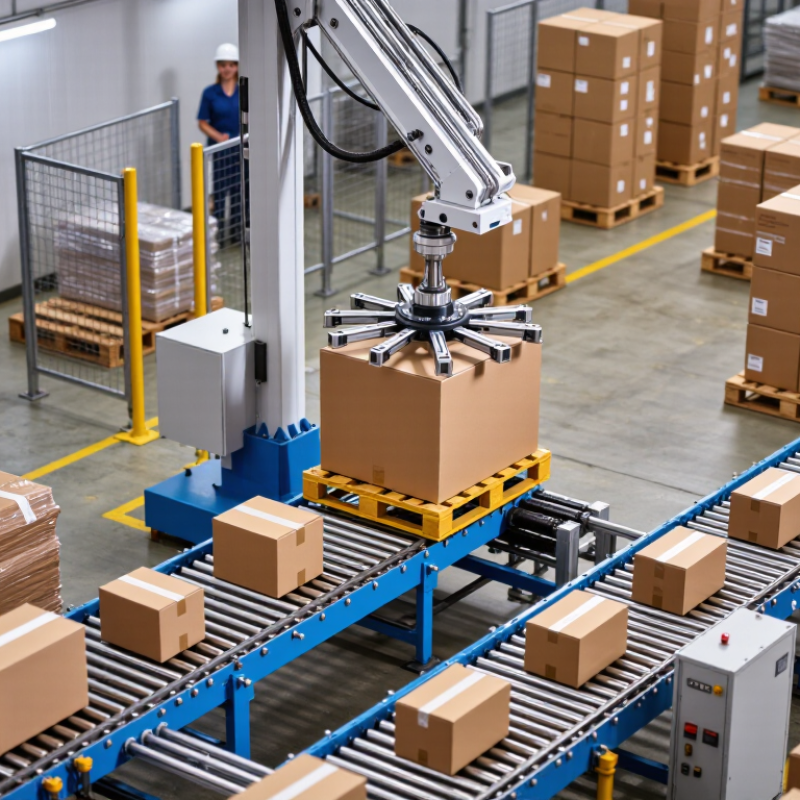
Assess Product Types, Payloads, and Pallet Patterns
Start with the products. Record each case’s dimensions, weight, surface, and daily mix. Heavy bags behave differently from slick cartons. Small, varied cases may need frequent pattern changes; uniform boxes can support faster, repeatable layers.
Payload means more than product weight. Include the gripper, tooling, and load position, then check the robot’s rated payload and wrist limits. The International Federation of Robotics’ World Robotics 2024 report recorded 541,302 industrial robots installed worldwide in 2023, following 553,052 in 2022, reported in its 2023 edition. These figures cover all industrial robot types, not palletizers, but show automation is widely deployed. Still, a global trend cannot size your cell.
Test pallet patterns with real cases. Compare column stacking for speed with interlocking layers for stability, and check overhang, total height, slip sheets, and pallet changes. A neat screen layout can fail on a dusty carton. Run sample loads through the proposed gripper and pattern; inspect shifting after turns and conveyor stops. There is no perfect pattern. A little trial-and-error is useful, though repeated manual rework signals that the design needs another look.
Measure Throughput Needs and Available Floor Space
Before comparing robot speeds, record the line’s actual output across several shifts, not just its best hour. Track cases or layers per minute, pallets per shift, and the busiest short interval. Include product changes, carton sizes, and pauses caused by upstream equipment. Averages hide peaks. For example, a line may average 24 cases per minute but briefly reach 32 after changeovers. Size around the sustained peak the cell must handle, while checking whether a short accumulation conveyor can absorb surges. These estimates are rarely perfect; shifts change, and cartons arrive unevenly.
On the floor, mark the robot’s full working envelope, including arm reach, pallet positions, the infeed conveyor, and guarding. Measure aisle width and keep clear access for pallet delivery, maintenance, and operator movement. A tape measure helps. Allow room for empty-pallet stacks and completed loads; these often consume more space than expected. Check ceiling height and overhead obstructions, especially around tall loads or lift equipment. A compact layout can look efficient on paper yet block a pallet change. Leave space for future adjustments, even if the exact need is uncertain.
Compare Robot Reach, End Effectors, and System Layouts
Choosing an automated palletizing robot starts with the full working envelope, not the reach figure on a sales sheet. Map the pickup point, pallet corners, gripper length, and safe recovery space. A long-reach arm may still struggle to place cartons near the floor or far pallet edge. Measure actual product sizes, including the occasional oversized case. Those awkward cases matter.
The end effector must match the load. Vacuum cups can handle smooth cartons quickly, while clamps may suit unstable or porous packages better. Test both with real cartons, including dusty surfaces and partly filled boxes. Small details change grip. The IFR’s World Robotics 2024 report counted 541,302 industrial robot installations worldwide in 2023; that figure covers all applications, not palletizing alone. Still, it shows how widely automation is being deployed. For layout planning, check conveyor direction, pallet exchange space, layer-sheet access, and forklift aisles together. A neat CAD drawing can hide a blocked maintenance route. I have seen that overlooked. Leave room for technicians to reach sensors and replace worn cups without moving the cell. Be honest about the trade-off: a compact layout saves floor space, but can make changeovers slower.
Check Safety, Integration, and Future Expansion
Safety should be checked on the actual palletizing cell, not only on a layout drawing. Map operator paths, pallet exchange points, and spots where cartons may shift or fall. Confirm that guards, interlocked gates, emergency stops, and scanner zones fit the real workflow. Keep room for safe recovery. A narrow aisle can turn a minor jam into a risky reach. Ask who resets faults and where they stand during the reset.
Integration deserves the same practical review. Check how the robot will communicate with conveyors, pallet dispensers, sensors, and the site’s control system. Agree on signal names, fault messages, and restart steps before installation. Test these handoffs with the line running at its normal speed. Test with real loads. Lightweight sample boxes may behave very differently from full cartons with uneven weight. The first plan may miss a detail; that is a reason to test early, not to skip testing.
Plan for change, too. Estimate likely product sizes, pallet patterns, and shifts in daily volume over the next few years. Ask whether new grippers, recipes, or conveyor sections can be added without rebuilding the whole cell. Check available floor space, power, and network capacity for those additions. Leave a marked expansion area where possible. Extra capacity costs money now, and guessing too high is not always wise. But a layout with no room to grow can make a modest production change surprisingly difficult.
10 Tips for Choosing an Automated Palletizing Robot
Compare the practical selection priorities below, with particular attention to safety, integration, and future expansion.
Illustrative planning ratings, not results from an industry survey. Use them as a starting point and validate requirements against your product, line layout, risk assessment, and growth plans.
Evaluate Total Cost, Support, and Supplier Experience
An automated palletizing robot’s price tag is only the visible part of the investment. Include end-of-arm tooling, guarding, conveyors, integration, commissioning, and operator training in the estimate. Then ask what happens when carton sizes change or production shifts run longer. Those details affect real costs. Budget for spare grippers, planned maintenance, software updates, and downtime during installation. A low quote may exclude useful items, while an oversized system can leave capacity unused. Compare cost per case over several years, not only the purchase price.
Support deserves equal scrutiny. Ask how quickly technicians respond, whether remote diagnostics are available, and which parts are stocked locally. Request a sample service schedule and a clear escalation path, not just a promise of help. Supplier experience matters most when your layout, loads, or product mix are unusual. Review projects with similar pallet patterns and payloads; ask what required rework after startup. If possible, speak with an operating site and watch a full changeover, including a minor fault. Notice how operators reach controls, clear jams, and resume safely. Good references reduce uncertainty, but they do not guarantee a perfect fit. I would still question optimistic throughput figures. Real lines are messy.