How to Choose a Cargo Electric Bike for Your Business?
Choosing a cargo electric bike for business is a practical decision, not a trend-driven purchase. The right model must carry your goods, protect your staff, and survive repeated daily use. Delivery routes, load weight, road surfaces, storage space, and charging access all matter. So does the rider’s comfort.
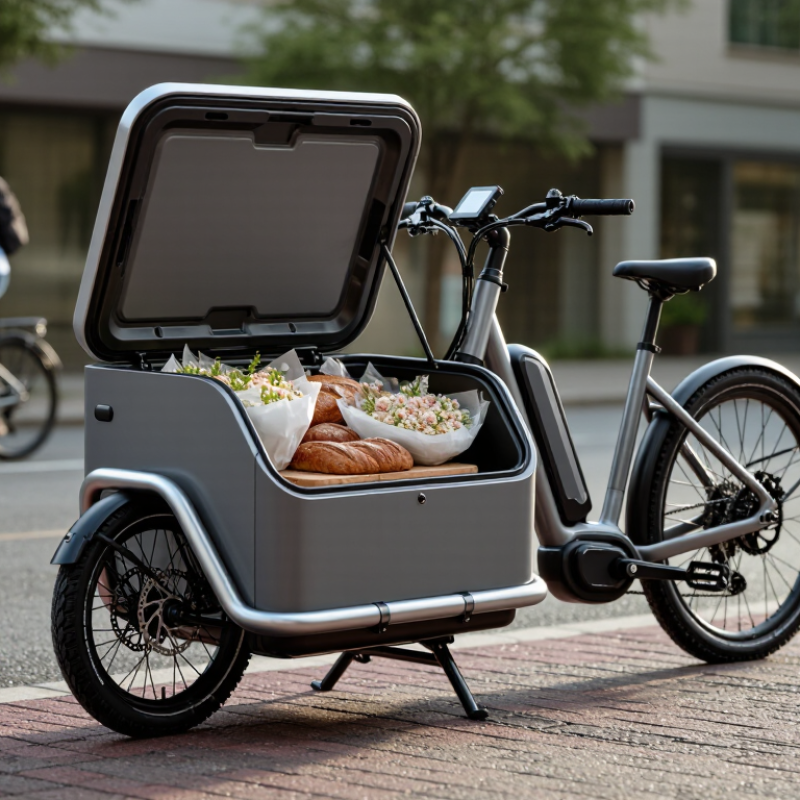
Urban cycling author and cargo-bike advocate Madi Carlson describes the concept simply: “A cargo bike is a minivan with two wheels.” That comparison is useful. A business needs more than a motor and a large box. It needs stable handling, dependable brakes, weather protection, accessible controls, and a battery that matches the working shift. A bakery may need insulated storage. A florist may need gentle suspension and upright cargo space. A maintenance company may value tool compartments over maximum speed.
Test before committing. Load the bike with realistic equipment, then ride it through tight corners, slopes, and uneven streets. Check how easily employees can mount, park, reverse, and recharge it. Ask suppliers about battery replacement, service response, warranty coverage, and spare parts. These details often decide the real operating cost.
There is no perfect cargo electric bike. That is worth admitting. A cheaper model may become expensive after frequent repairs. A larger battery may add weight that slows handling. Some businesses also overestimate daily mileage. Track actual routes for one week before choosing specifications. A careful trial, honest cost calculation, and clear business purpose will produce a more reliable investment.
Map Business Demand: Loads, Routes, Stops, and Required Daily Range
How to Choose a Cargo Electric Bike for Your Business?
Map Business Demand: Loads, Routes, Stops, and Required Daily Range
Begin with the work, not the bike. Record each load’s weight, dimensions, loading time, and delivery priority. The World Economic Forum projects urban last-mile delivery emissions will rise 32% by 2030. More stops will also increase route pressure. Map every stop.
Measure real routes over several working days. Note hills, road surfaces, traffic delays, waiting time, and secure parking. Do not average everything. A route with 35 stops differs greatly from one with five heavy deliveries. The European Cyclists’ Federation estimated that cargo bikes could replace about half of motorised delivery trips in European cities. That figure is useful, but local access rules and customer density still matter.
Calculate daily range from actual energy demand, not the advertised maximum. Include payload weight, weather, hills, stop-start riding, and battery ageing. Leave a practical reserve of 20% to 30%. A vehicle that finishes with no reserve is not reliable. Also compare shift length with charging time and battery-swapping procedures. My first route model would have ignored loading delays. That mistake is easy to repeat. Test the busiest day, then test the worst weather day. Use measured data from a pilot week before approving the final specification. (World Economic Forum, The Future of the Last-Mile Ecosystem, 2020; European Cyclists’ Federation, CycleLogistics studies)
Screen Payload: Commercial Cargo Bikes Often Rate 150–250 kg Gross
How to Choose a Cargo Electric Bike for Your Business?
Payload is the first number to examine. Commercial cargo bikes often rate 150–250 kg gross. That figure includes the rider, battery, bike, tools, and cargo. It does not mean you can load 250 kg of parcels.
A 90 kg rider and a 35 kg bike leave only 125 kg from a 250 kg rating. Add two batteries, rain equipment, and a lock. The usable payload falls again. This calculation is easy to overlook. I have seen operators focus on box volume while ignoring axle limits. That mistake can affect braking, steering, tire wear, and delivery stability. Ask for separate limits for the total vehicle, front platform, rear rack, and trailer. Also check whether the rating applies to steep roads and uneven surfaces.
Industry evidence supports careful replacement planning. The World Economic Forum reported in 2020 that urban last-mile emissions could rise by 32% by 2030 without intervention. DHL Trend Research also identified cargo bikes as practical tools for dense delivery routes, especially where parking delays slow vans. Yet reports rarely capture every local condition. A 180 kg rating may work for lightweight parcels, but not for dense food crates or construction materials. Test the bike on your real route, with a full load, repeated stops, and one uncomfortable hill. The result may challenge your original choice.
Commercial cargo electric bikes commonly fall within a 150–250 kg gross payload range. Gross payload includes the rider, cargo, accessories, and other carried weight, so businesses should select a rating that leaves enough capacity for their actual delivery requirements.
Select Power: 400–750 Wh Batteries and a 20 mph Class 1 Limit
Choosing a cargo electric bike for business starts with matching battery capacity to daily work. A 400 Wh battery may suit short deliveries, local errands, or lighter loads. A 750 Wh battery offers more usable energy for longer routes, hills, and repeated stops. However, capacity alone does not guarantee range. Rider weight, cargo weight, tire pressure, wind, temperature, and assist settings all affect consumption.
In real delivery work, I would track one full shift before ordering several bikes. Record distance, battery percentage, payload, and charging time. This simple log reveals whether a smaller battery is genuinely practical. A larger battery also adds weight, which can make loading and tight turns harder. That trade-off is easy to overlook. Leave some reserve energy for unexpected detours, because running empty beside a busy road is not a good operating plan.
For many U.S. routes, a Class 1 electric bike provides pedal assistance up to 20 mph without motor assistance beyond that limit. This speed can support steady urban travel while keeping handling manageable around pedestrians and parked vehicles. Confirm local definitions before purchasing, since regulations differ between regions. Train riders to reduce assist on crowded paths and wet surfaces. A 20 mph limit sounds modest, yet a heavy cargo bike can build momentum quickly. Test the bike with the actual business load, not an empty basket.
Model Total Cost: Energy, Maintenance, Financing, and Payback per Delivery
Choosing a cargo electric bike for business starts with the total cost, not the purchase price. A lower-priced model may consume more energy or require frequent repairs. Calculate electricity, maintenance, financing, insurance, and expected resale value over three years.
For example, a delivery bike traveling 60 kilometers daily may use about 1.5 to 2.5 kWh. Multiply that figure by your local electricity rate and working days. Add tire replacements, brake adjustments, battery checks, and occasional downtime. Maintenance records from similar routes can improve your estimate, but real conditions vary. Heavy loads, steep streets, and poor storage can shorten component life.
Financing changes the payback period. Compare the monthly payment with the cost of fuel, parking, and van use replaced by each bike. Then divide the monthly operating savings by completed deliveries. If the bike saves 900 dollars monthly and costs 600 dollars in financing and upkeep, the remaining 300 dollars supports payback. Simple, but not perfect.
Track actual results for eight weeks. Record energy use, repair hours, delivery distance, and missed orders. Numbers can disappoint. A bike may look profitable until battery replacement enters the calculation. Weather also matters. Rainy weeks can reduce delivery speed and increase maintenance. Leave a realistic reserve, and test the route with the heaviest normal load before committing to a fleet.
How to Choose a Cargo Electric Bike for Your Business? – Model Total Cost: Energy, Maintenance, Financing, and Payback per Delivery
Illustrative operating-cost comparison: generic cargo e-bike configurations versus a conventional urban delivery van. Currency: USD.
| Model Profile | Payload | Purchase Price | Battery / Rated Range | Typical Monthly Mileage | Energy Cost / Delivery | Maintenance / Delivery | Financing / Delivery | Total Cost / Delivery | Simple Payback | Best Fit |
| A. Vehicle and Operating Assumptions |
| Compact Cargo E-Bike | Up to 150 kg
330 lb | $5,500 | 1.5 kWh / 60 mi | 800 mi | $0.08 | $1.40 | $3.44 | $5.80 | 3.0 months | Short urban routes |
| Standard Cargo E-Bike Balanced | Up to 200 kg
441 lb | $7,500 | 2.0 kWh / 65 mi | 800 mi | $0.10 | $1.80 | $4.69 | $7.59 | 3.5 months | Mixed delivery loads |
| Long-Tail Heavy-Duty E-Bike | Up to 250 kg
551 lb | $10,500 | 2.5 kWh / 70 mi | 800 mi | $0.11 | $2.40 | $6.58 | $10.34 | 4.0 months | Heavy or bulky goods |
| Conventional Urban Delivery Van | Approximately 900 kg
1,984 lb | Lease or purchase varies | Gasoline / 25 mpg | 800 mi | $7.20 | $3.60 | $16.25 | $28.85 | Baseline | Long routes and high volume |
| B. Monthly Cost Build-Up Per Vehicle |
| Model Profile | Monthly Energy | Monthly Maintenance | Monthly Financing | Insurance / Parking | Total Monthly Cost | Deliveries / Month |
| Compact Cargo E-Bike | $3.20 | $56.00 | $137.72 | $35.00 | $231.92 | 40 |
| Standard Cargo E-Bike | $3.94 | $72.00 | $187.76 | $40.00 | $303.70 | 40 |
| Long-Tail Heavy-Duty E-Bike | $4.57 | $96.00 | $263.05 | $50.00 | $413.62 | 40 |
| Conventional Urban Delivery Van | $288.00 | $144.00 | $650.00 | $72.00 | $1,154.00 | 40 |
| C. Financial Comparison and Payback |
| Model Profile | Monthly Cost Saving vs. Van | Annual Cost Saving vs. Van | Upfront Payment Assumption | Annual Deliveries | Payback Formula | Result |
| Compact Cargo E-Bike | $922.08 | $11,064.96 | 20% down payment: $1,100 | 480 | Purchase price ÷ annual saving | 0.50 years |
| Standard Cargo E-Bike | $850.30 | $10,203.60 | 20% down payment: $1,500 | 480 | Purchase price ÷ annual saving | 0.74 years |
| Long-Tail Heavy-Duty E-Bike | $740.38 | $8,884.56 | 20% down payment: $2,100 | 480 | Purchase price ÷ annual saving | 1.18 years |
| D. Cost Calculation Notes |
Energy: calculated using a commercial electricity rate of $0.16/kWh and the stated battery capacity and rated range.
Maintenance: includes routine inspections, tires, brake components, drivetrain wear, and scheduled service; it excludes accident damage.
Financing: based on a 36-month loan at an illustrative 8% annual interest rate with a 20% down payment.
Operating pattern: 20 miles per delivery, 40 deliveries per month, and 800 vehicle miles per month.
Van baseline: $0.45/mile for fuel, $0.18/mile for maintenance, $650 monthly finance or lease cost, and $72 monthly insurance and parking.
Exclusions: labor, taxes, depreciation, charging infrastructure, permits, financing fees, resale value, downtime, and delivery revenue are not included.
Interpretation: the payback result is a simple operating-cost payback against the van baseline. Actual results vary with mileage, delivery density, electricity prices, financing terms, payload, weather, and local labor costs. |
Practical selection rule: choose the compact configuration when payload and route length are limited; choose the standard configuration for the broadest mix of urban deliveries; choose the heavy-duty configuration when higher payload capacity reduces the number of trips or prevents the need for a second vehicle.