How to Choose the Right Marine Flex Hose?
Marine flex hose is easy to underestimate. It may carry fuel, cooling water, exhaust, or bilge water, yet each service demands different materials and construction. A hose that looks substantial can still soften, crack, or kink when exposed to the wrong fluid, heat, pressure, or bend radius. Small details matter: a tight turn behind an engine, a clamp near a fitting, or constant vibration can change how a hose performs over time.
The U.S. Coast Guard’s 2023 Recreational Boating Statistics report recorded 3,844 recreational boating accidents and 564 deaths. These figures do not identify hose failures as a specific cause, but they underline why dependable onboard systems deserve careful attention. For fuel applications, ISO 7840 addresses fire-resistant hose requirements, while ISO 8469 covers non-fire-resistant fuel hoses. These standards apply to defined uses; they are not a substitute for checking a manufacturer’s documentation or the vessel’s requirements.
Choosing the right Marine Flex Hose starts with the service, not the price or appearance. Confirm the fluid, operating temperature, pressure, suction demands, inside diameter, bend radius, and fitting compatibility. Then check resistance to abrasion, oil, heat, and sunlight where relevant. Look for clear product markings and installation guidance. A thick wall can feel reassuring, but that alone proves little. Even a correctly rated hose can fail if it is twisted, over-bent, or poorly supported. Careful selection helps; regular inspection still matters.
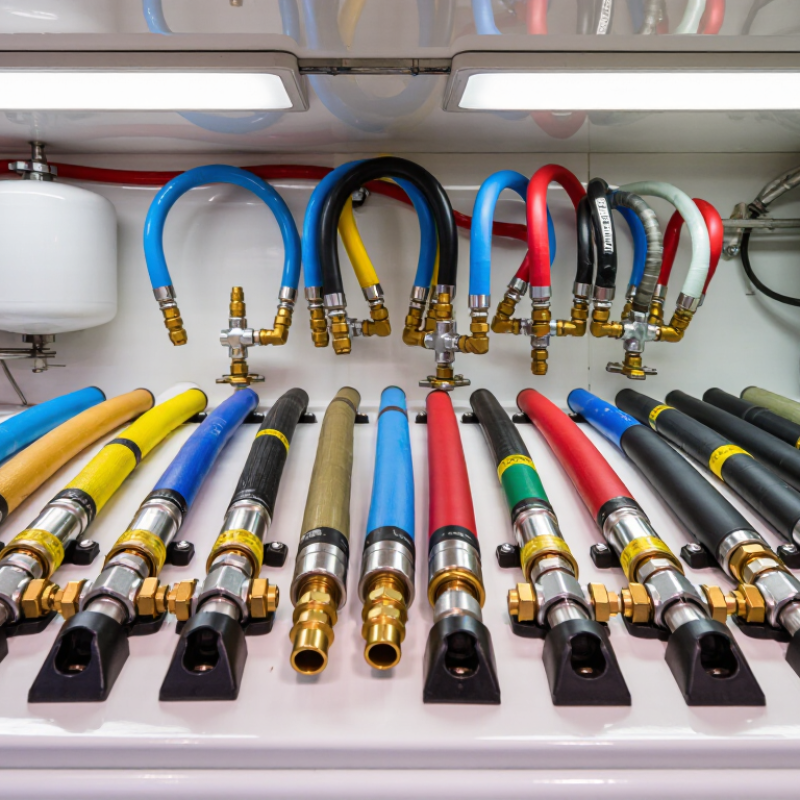
Identify the Hose’s Purpose and Marine Application
A marine flex hose should be chosen for the job it performs, not just its diameter. Fuel, exhaust, bilge, potable-water, and steering systems face different pressures, temperatures, and fluids. A hose that works for a bilge pump may soften or fail when exposed to fuel. That distinction matters.
Start by tracing the hose’s route and checking what flows through it. Fuel lines need materials and construction suited to marine fuel service; ISO 7840 specifies requirements for fuel hoses on small craft. Exhaust hose must tolerate hot, wet exhaust and engine vibration. For potable water, confirm the hose is suitable for drinking-water contact. Measure the inside diameter, bends, and connection points, too. A tight bend can kink a hose even when the fittings match.
The U.S. Coast Guard’s 2023 Recreational Boating Statistics report recorded 3,844 boating incidents, 564 deaths, and 2,126 injuries. These figures do not show that hose failures caused those incidents, but they underline why dependable vessel systems deserve careful attention. Look for the application and temperature ratings on the hose, then compare them with the vessel manual and operating conditions. Labels can be easy to overlook. I would also inspect the full route for chafe, heat, and clamps; a correct hose in a poor installation is still a concern.
Match Hose Materials to the Fluid and Operating Environment
A marine flex hose should be selected for the fluid it carries, not just its diameter. Fuel, oil, coolant, seawater, and exhaust condensate can affect hose materials differently. Nitrile-based hose is commonly used for fuel and oil, but confirm that the specific hose is rated for the fuel blend in your system. EPDM often suits coolant and water service, yet it is generally a poor choice for petroleum products. Small details matter.
Then consider the route and operating conditions. A hose in an engine compartment may face heat, vibration, and contact with oil. A run near a deck fitting may see sunlight, salt spray, and repeated flexing. Check the hose’s temperature and pressure limits, bend radius, and resistance to the fluid—not just its outer covering. For exhaust service, use hose specifically designed for the temperature and wet-exhaust conditions involved. Ordinary water hose is not an adequate substitute.
I have seen material choice receive more attention than installation, though both matter. A compatible hose can still fail if it is kinked, stretched over a fitting, or compressed by an unsuitable clamp. Leave room for movement, inspect markings, and follow the hose maker’s compatibility guidance. If the fluid or exposure is uncertain, pause and verify the specification rather than relying on appearance. It is not always obvious.
Check Pressure, Temperature, and Engine Compatibility
A marine flex hose must match the pressure it will actually face, not just the system’s usual reading. Check the hose’s working-pressure rating and account for brief surges during startup or changing engine loads. A rating is only useful within its stated temperature range. Hot fluid can reduce a hose’s pressure capacity, so read the specifications carefully.
Temperature matters at the hose surface and inside it. A coolant hose near a warm engine may face heat, vibration, and contact with nearby parts. Exhaust applications need hose specifically rated for that service; an ordinary water hose is not a safe substitute. Check the minimum and maximum operating temperatures, including cold starts.
Small detail, big consequences.
Then confirm compatibility with the engine system and the fluid being carried. Fuel, oil, coolant, and raw water can require different hose materials and construction. Match the inside diameter to the fitting, and allow for the manufacturer’s minimum bend radius. A tight curve can flatten the hose. It happens. Verify the engine manual and hose data sheet together; fitting neatly is not proof of compatibility. If the application remains unclear, ask a qualified marine technician before installation.
Choose the Correct Diameter, Length, and Bend Radius
How to Choose the Right Marine Flex Hose?
Choosing the correct diameter starts with the hose’s actual inside diameter and the fittings it must connect to. A mismatch can restrict flow or create a poor seal. Check the equipment requirements, fluid type, operating temperature, and pressure, including pressure surges. The hose’s rated working pressure must suit the system; appearance alone tells you very little.
Measure the full route between connection points, including the space needed to fit each end without twisting the hose. A little extra length can ease installation, but too much may create a sag that rubs against a sharp edge. Check the specified minimum bend radius, usually measured along the hose’s centerline. Keep bends gradual, and avoid forcing a tight turn near a fitting. A tidy route can still be wrong if it kinks under engine movement.
Tips: Measure twice. Check the hose maker’s bend-radius guidance before cutting. Leave clearance from hot surfaces and moving parts, and inspect the run after securing it. If the route looks cramped, pause and reconsider it; a small layout change may prevent wear later. The easy choice is not always the sound one.
How to Choose the Right Marine Flex Hose
Start with the required hose bore, then verify the routed length and the hose’s minimum bend radius.
Reading the chart: Values are exact inch-to-millimeter conversions for common nominal sizes, not flow-rate recommendations. Match the hose bore to system requirements and connection sizes. Measure length along the installed route, and check the hose manufacturer’s specification for its minimum bend radius; both depend on the installation and hose construction.
Verify Marine Standards and Installation Requirements
A marine flex hose must match its service, not just its diameter. Fuel, cooling water, sanitation, and exhaust systems have different demands. For fuel, check whether the hose is certified to SAE J1527 or ISO 7840, as applicable to the vessel and local requirements. These standards address marine fuel-hose performance; they are not interchangeable with general-purpose hose ratings. Read the printed markings and confirm the hose’s approved use, fuel compatibility, temperature range, and pressure rating. Labels matter.
Installation can defeat a compliant hose. Follow the vessel’s approved drawings and the hose maker’s bend-radius and fitting instructions. A tight bend behind an engine, a clamp biting into the cover, or contact with a hot surface can cause early damage. Leave enough slack for engine movement, support long runs, and keep hose away from sharp edges. After fitting, inspect every connection for kinks, chafing, and leaks. I still find cramped compartments easy to underestimate.
The U.S. Coast Guard’s 2023 Recreational Boating Statistics recorded 3,844 reportable accidents and 564 deaths. Those figures are not hose-specific, but they reinforce the value of careful maintenance. Record the hose standard, size, installation date, and inspection findings. Recheck the run after the first operating hours; a clamp can loosen as parts settle. Verify local requirements, too, since a vessel’s flag, system type, and installation location may change which rules apply.