
China Top HDPE Floaters Supplier?

Choosing a China-based supplier for Hdpe Floaters starts with a practical question: will the product suit your water, load, and installation conditions? A supplier may offer attractive prices, broad size ranges, and custom colors. Those details matter, but they do not prove consistent quality. They matter. Float dimensions, wall thickness, resin grade, UV resistance, and connection design can affect buoyancy and service life. Ask how each specification is measured, not just what appears on a product sheet. Small gaps count. A floater used on a calm pond may not perform the same way in a windy, exposed site. Even a well-made product can be a poor match.

This guide looks at how to compare manufacturers and suppliers in China without relying on slogans like “top quality.” Review production experience, quality-control procedures, sample consistency, and available test records. Request clear drawings, material details, and written tolerances. Ask whether the quoted product is made in-house or sourced from another factory. That answer can change lead times and accountability. Check recent project references where possible, and confirm that photographs match the product being quoted. A polished catalog is not enough. No checklist is perfect; site conditions and installation choices still matter. Compare suppliers against the same requirements, then clarify packaging, delivery schedules, and after-sales support before ordering. The goal is not simply to find a low price or a familiar name. It is to identify a supplier whose claims can be checked and whose product fits the job.
China Top HDPE Floaters Supplier?

HDPE Floater Fundamentals: Uses, Structure, and Buoyancy Requirements

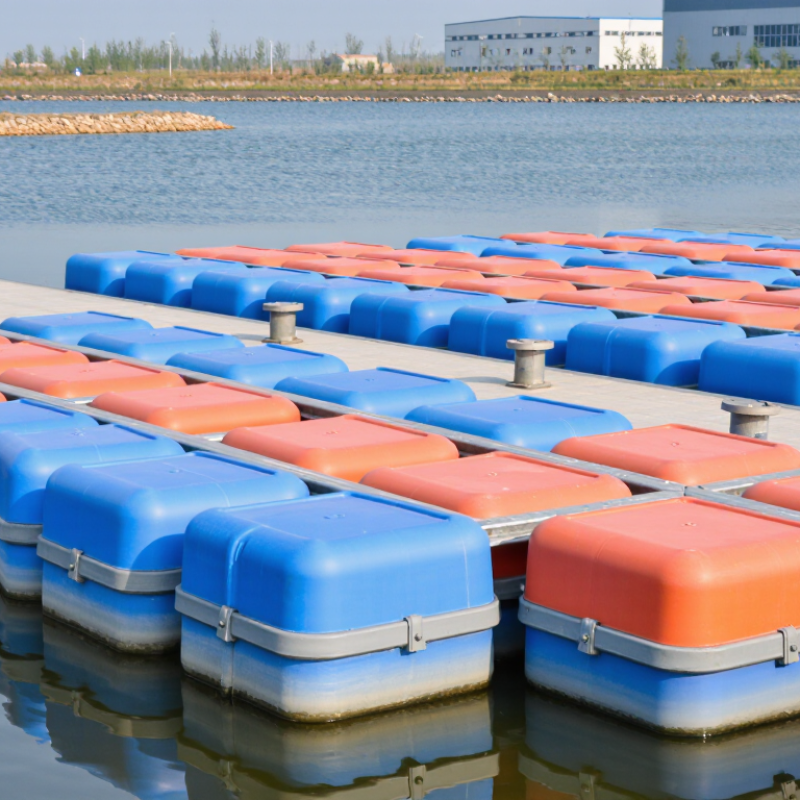
HDPE floaters support floating docks, walkways, aquaculture equipment, and utility platforms. Their job is simple to describe: displace enough water to carry the structure and its working load. The calculation is less simple. People, tools, waves, and uneven loading all affect performance.

Many floaters use a molded HDPE shell shaped to limit water entry and resist knocks. Some are hollow; others contain foam for added protection if the shell is damaged. Connections, wall thickness, and UV exposure matter too. A solid-looking unit can still fail at a weak mounting point. That matters.

Buoyancy depends on displaced water volume, water density, and total load. Designers also allow freeboard, the height remaining above the waterline, rather than sizing a floater to barely stay afloat. Saltwater provides slightly more lift than freshwater, but site conditions deserve measurement, not guesswork. Waves and current can shift loads in ways a tidy drawing misses. Not quite predictable. Check payload, spacing, attachment details, and inspection needs against the actual installation. There is no single buoyancy figure that suits every dock or work platform, and that is easy to underestimate.

Material Benchmark: HDPE Density of 0.941–0.965 g/cm³ (ISO 1183-1)

A reliable HDPE floater check starts with the resin, not the product label. The benchmark of 0.941–0.965 g/cm³ describes a useful material range, but it is not a complete buoyancy guarantee. ISO 1183-1:2019 specifies methods for measuring the density of non-cellular plastics, including immersion and liquid pycnometer methods. Ask for a batch test report that states the measured value and method. Small differences matter.

At 0.965 g/cm³, unfilled HDPE remains less dense than fresh water, but a finished floater also carries its shell, fittings, and any trapped water. Pigments or mineral fillers may raise resin density, so compare the certificate with the delivered grade. PlasticsEurope’s Plastics – the Facts 2023 reports 400.3 million tonnes of global plastics production in 2022, underscoring the scale of material supply—not the quality of any single batch. Check the details yourself. A density figure without traceable batch data is weak evidence, and even a good certificate cannot replace a buoyancy test on the finished floater.

Floater Sizing: Apply Archimedes’ Principle to Calculate Displacement

China Top HDPE Floaters Supplier?

Floater Sizing: Apply Archimedes’ Principle to Calculate Displacement

When comparing HDPE floaters, size them by displacement, not appearance. Archimedes’ principle says a floating body displaces water equal to its supported mass. Estimate required volume by dividing total system mass by water density. Include the floaters, deck, fittings, people, and equipment. UNESCO’s 1983 seawater algorithms calculate density using salinity, temperature, and pressure. For a rough estimate, seawater is often treated as 1,025 kg/m³. Local conditions can differ.

For a 500 kg total system mass, full immersion would require about 0.488 m³ of displacement in seawater. That leaves no reserve. With a 30% reserve, target about 0.697 m³ (500 ÷ 1,025 × 0.70). Check external volume against product drawings and permitted immersion depth. Small details matter. This remains an estimate; real loading and waves are less tidy than the calculation.

Supplier Checks: Review ASTM D3350 Resin Data, UV Resistance, and Quality Tests

Choosing a China-based HDPE floater supplier takes more than comparing unit prices. Ask for the resin data sheet and check its ASTM D3350 classification, including density, melt index, tensile strength, and slow-crack-growth properties. These values help describe the material, but they do not prove that a finished floater will perform well in your water conditions. Request traceable batch records, too.

UV resistance deserves a practical check. Ask what stabilizers or pigments are used, and request results from a documented weathering test. Compare exposed samples for fading, chalking, cracking, or changes in strength. Test duration and conditions matter. A brief test is not a lifetime guarantee.

Look closely at finished-product quality controls. Useful checks include wall-thickness measurements at several points, dimensional inspection, impact testing, and leak or buoyancy tests. Ask how often each test is performed and whether failed units are recorded. A sample can look solid on a sunny factory floor. That alone tells you little about years of heat, water, and handling. Test reports can also be incomplete, so clarify methods and acceptance limits before placing an order.

Compare China Suppliers by Load Rating, Dimensions, Certifications, and Lead Time

China Top HDPE Floaters Supplier?

A useful supplier comparison starts with the load rating, not the lowest quoted price. Ask whether the figure refers to static load, working load, or a tested assembly. These are not interchangeable. For a floating platform, request test conditions and safety margins, then compare them against expected users, equipment, and wave exposure. A rating without test details is hard to assess.

Dimensions affect fit, buoyancy, and installation. Compare length, width, wall thickness, connector spacing, and stated tolerances. A 500 mm module may look standard on paper, yet small connector differences can complicate assembly. Check whether the supplier can provide drawings and a sample for measurement. I once focused too much on the headline dimensions. That missed the connection points.

Review material records and relevant quality certificates, but confirm what each document covers and whether it matches the actual product. Ask about UV resistance, resin traceability, and inspection records. Lead time needs the same scrutiny. Separate sample production, tooling, manufacturing, and shipping estimates; request a current schedule in writing. A short quoted lead time is not always a dependable one. Compare suppliers using the same specifications, and leave room for delays.

Article Source:

Go to Top