What Is the Best Sensor Street Light from China?
Choosing the best Sensor Street Light from China requires more than comparing prices or LED wattage. The right product must perform reliably on real roads, in changing weather, and under repeated maintenance cycles. The International Energy Agency reports that lighting uses about 15% of global electricity consumption. This makes efficient street lighting an important public-infrastructure decision, not merely a lighting upgrade.
China has a mature manufacturing ecosystem for LED drivers, radar sensors, photovoltaic modules, and smart-control systems. However, product quality varies widely between factories. A strong candidate should offer stable dimming, accurate motion detection, IP66 protection, surge resistance, and clear test documentation. Compliance with standards such as IEC 60598-1 and IEC 60598-2-3 is essential. Certifications alone are not enough. Buyers should also examine thermal testing, battery-cycle data, driver efficiency, and spare-parts availability.
Field experience often reveals the difference. A light may dim correctly in a showroom but respond slowly beside a wet road. A radar sensor may detect bicycles accurately yet trigger unnecessarily near trees. The U.S. Department of Energy has documented substantial energy-saving potential from LED street lighting, especially when controls reduce output during low-traffic periods. Still, poor settings can reduce safety or increase complaints. Therefore, this guide compares Chinese Sensor Street Light options through measurable performance, installation conditions, after-sales support, and lifecycle cost. There is no universal winner. The best choice depends on road width, traffic patterns, climate, grid access, and maintenance capability.
What Is a Sensor Street Light from China?
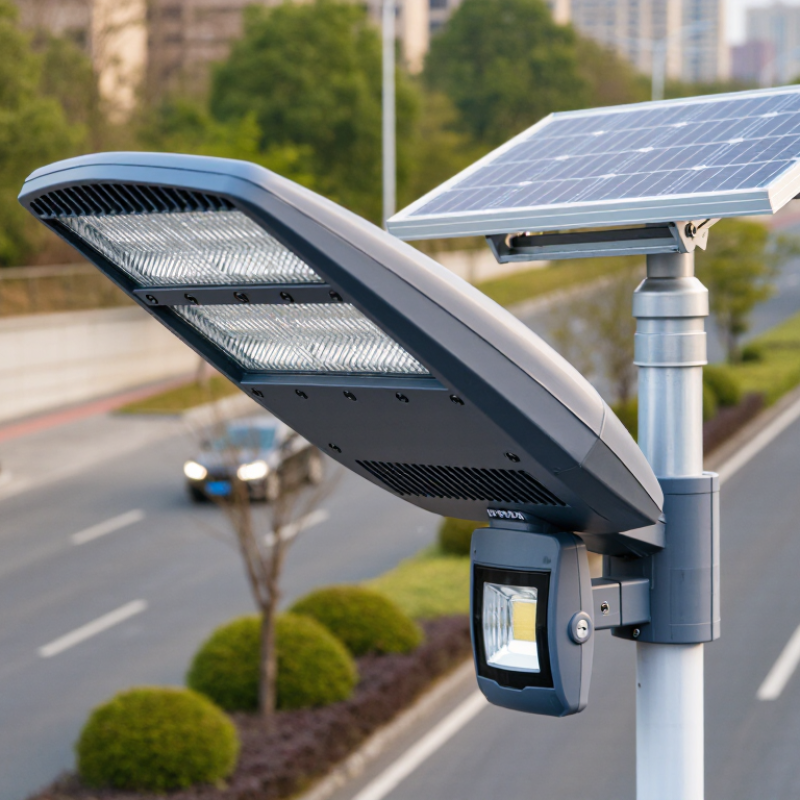
A sensor street light from China is an outdoor lighting unit made in China with automatic detection features. It usually combines an LED module, a control driver, and a motion or light sensor. The sensor detects movement, nearby brightness, or both. This allows the lamp to brighten when pedestrians, cyclists, or vehicles approach.
Many models use a microwave sensor, infrared sensor, or radar-based detector. A dusk-to-dawn sensor can switch the light on when sunlight fades. Some systems keep a road section at 30% brightness, then raise it to full output within seconds. In a residential lane, this can reduce wasted electricity while preserving visibility near gates and crossings. Battery-powered versions may include a solar panel, lithium battery, and programmable controller.
Quality depends on more than the country of manufacture. Buyers should check photometric test reports, ingress protection ratings, temperature performance, and electrical safety documents. Installation height also matters. A sensor mounted too low may react to passing animals. A poor angle can leave a dark area beneath the fixture. Real sites are rarely perfect. Rain, tree movement, dust, and cold weather can cause false triggers or delayed responses. I would test a sample for several nights before ordering in volume, while checking local road-lighting rules and maintenance access. Sensor street lights from China can be practical, but their settings require careful adjustment.
How Do China-Made Sensor Street Lights Work?
China-made sensor street lights combine LED modules, motion sensors, light controls, and power management in one outdoor system. A photocell measures surrounding brightness and turns the lamp on after dusk. During quiet hours, the controller may keep the LEDs at a low setting. When a person, bicycle, or vehicle enters the detection area, the sensor sends a signal. The controller then raises the brightness, often within a second.
Many models use passive infrared sensors, microwave radar, or both. Infrared sensors detect body heat and movement, while radar can respond more consistently through light rain or dust. Solar versions charge a battery during daylight and use stored energy overnight. In my experience, installation height and sensor direction matter as much as the hardware. A sensor facing a busy road may trigger repeatedly. A narrow path may need a wider detection angle. Performance can also change in winter, when batteries hold less energy.
Tips: Check the detection range, standby brightness, battery capacity, and waterproof rating before purchase. Test the light after sunset, not only in a showroom. Watch for delayed reactions, false triggers, and uneven illumination. The “best” street light depends on traffic, weather, pole spacing, and maintenance access. A cheaper unit may work well in a quiet lane, but it may struggle beside trees, parked vehicles, or reflective walls. Specifications are useful, but field testing reveals the weaknesses.
How to Compare Chinese Sensor Street Light Manufacturers?
What Is the Best Sensor Street Light from China?
Comparing Chinese sensor street light manufacturers requires more than checking unit prices. Start with the product’s real operating conditions. Ask for the LED chip specification, lumen maintenance data, battery cycle test, and sensor detection range. A reliable manufacturer should provide IES files, protection ratings, and clear installation instructions. Look for IP66 or higher outdoor protection and suitable IK impact resistance. Ask whether these ratings apply to the complete fixture, not only its housing.
Request a working sample before placing a large order. Test it beside a road, not only inside a showroom. Check motion response at different distances, dimming speed, charging performance, and lighting time after several cloudy days. A practical supplier should explain its solar panel sizing method for your local sunlight conditions. It should also identify battery chemistry, operating temperature, and replacement procedures. Small details matter.
Factory experience is visible in testing records, wiring quality, sealing, and packaging. Ask how each batch is inspected and how defects are handled. Verify production capacity through a video audit or independent inspection. Certifications should match your destination market and the actual model supplied. I once focused too heavily on warranty length and missed the cost of replacing a battery assembly. That mistake changed my comparison sheet. Price still matters, but service response, spare parts, and documented performance often matter more. No manufacturer gets every point right. Expect questions, evidence, and a few uncomfortable gaps.
How to Choose the Right Sensor Street Light for Your Project?
Choosing the right sensor street light for a China-sourced project starts with site evidence, not catalog brightness. The International Energy Agency reports that lighting uses about 15% of global electricity consumption. That makes control quality as important as LED efficiency. Record road width, traffic patterns, mounting height, weather, and nearby reflective surfaces. A narrow road may need microwave sensing, while a busy intersection requires stable dimming and rapid recovery.
Ask suppliers for measured photometric files, not only lumen claims. Verify light distribution, glare control, color temperature, and performance at the intended pole height. For public roads, request LM-80 and TM-21 LED data, surge protection details, thermal testing, and an IP66 or higher enclosure where exposure is severe. The U.S. Department of Energy notes that networked lighting controls can produce meaningful savings, but results depend on commissioning and operating schedules. Sensors should therefore offer adjustable detection zones, hold times, and dimming levels.
Test before ordering at scale. Check false triggers from trees, rain, and parked vehicles during several nights. Confirm whether the controller keeps a safe output after communication failure. China-based production can provide flexible housing, optics, and control configurations, but low price can hide weak driver protection or inconsistent calibration. I would avoid choosing by wattage alone. A 100-watt fixture with poor optics may illuminate less evenly than a lower-power model. Even good specifications need field validation, because real streets are rarely as predictable as drawings.
What Is the Best Sensor Street Light from China?
Choosing the right sensor street light depends on detection range, motion sensitivity, false-trigger resistance, and suitability for the installation environment. The chart below shows typical outdoor detection ranges by sensor technology; actual performance varies with mounting height, weather, lens design, and product settings.
How to choose: PIR sensors are suitable for low-cost pedestrian areas, microwave sensors offer broader coverage, and mmWave or dual-technology sensors are better for roads and sites requiring reliable detection in changing weather conditions.