
Best MCB Assembly Robot Manufacturer in China?
Choosing the Best Mcb Assembly Robot Manufacturer in China requires more than comparing machine prices. The right partner should understand miniature circuit breaker assembly, product tolerances, and the realities of factory production. An Mcb Assembly Robot may handle feeding, component placement, fastening, testing, or several linked operations. Its value depends on how reliably those steps match your product and required output. Small details matter. A feeder that jams during a shift can disrupt an otherwise impressive production line. So can a changeover that takes longer than expected.
A useful evaluation starts with clear evidence. Ask manufacturers for cycle-time data tied to a comparable MCB, not only a headline figure. Review sample parts, inspection records, machine layout, safety features, and the proposed plan for integration. Clarify which tasks are included, what operators must do, and how service support works after installation. No brochure answers everything. If possible, arrange a factory visit or a witnessed acceptance test using your own components. Compare documentation and response quality, too; both reveal how carefully a supplier handles technical questions. There may be no single best manufacturer for every buyer. A high-speed system may suit stable, large-volume production, while flexible tooling may matter more when models change often. The strongest choice is the one whose claims can be checked against real operating conditions. Even then, leave room for doubt until the line runs consistently.
What Is an MCB Assembly Robot?
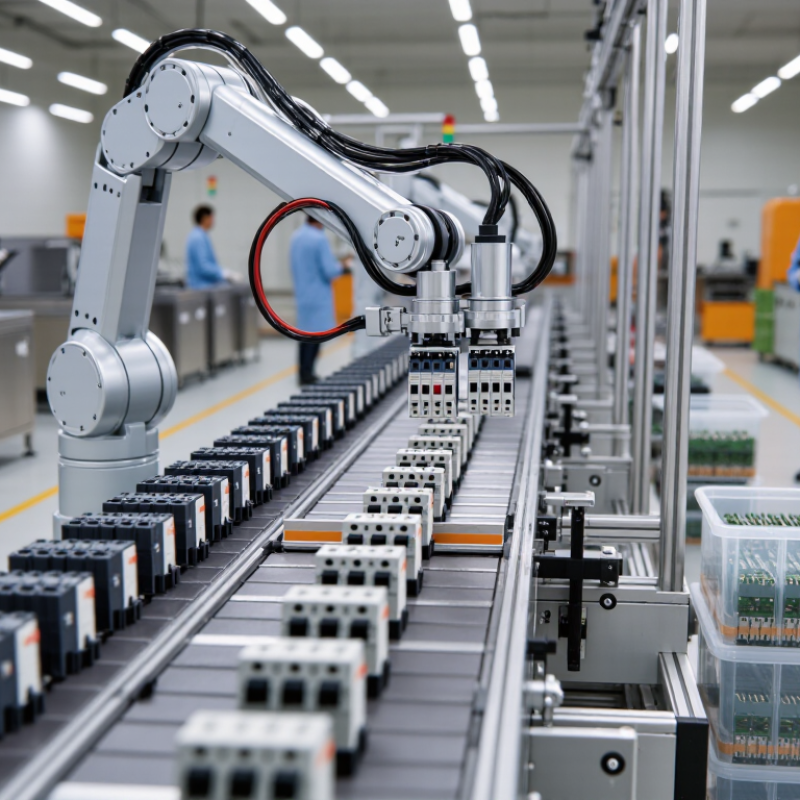
An MCB assembly robot is an automated cell designed to position and join the small components inside a miniature circuit breaker. Depending on the product and production volume, it may handle housings, contacts, springs, terminals, and arc-chute parts. A typical cell combines a robot with part feeders, fixtures, fastening tools, sensors, and a programmable controller. It is more than a robot arm.
Feeders orient parts before the robot places them in a fixture. Vision cameras can check position or confirm that a component is present. A controlled driver then tightens screws to a set torque, while sensors monitor key steps. Separate stations may test mechanical operation and electrical performance. Fast is not enough. Repeatable placement and reliable checks matter more.
In practice, the process is less tidy than a diagram suggests. Tiny parts can vary, feeders can jam, and a poorly designed fixture can cause repeated stops. A robot cannot compensate for inconsistent components or unclear assembly tolerances. When assessing a system, ask how it handles product changeovers, fault recovery, and test records. These details reveal whether the cell suits real factory conditions, not just a demonstration.
How Does an MCB Assembly Robot Work?
An MCB assembly robot combines feeding, positioning, fastening, and inspection steps in a controlled sequence. Vibratory feeders or trays present small components, while sensors confirm that parts are available and correctly oriented. A vision camera can check features such as contact position or housing alignment. The robot then moves parts between stations using grippers designed for their shape. Small parts matter. A misplaced spring or contact can affect the finished breaker, so detection and positioning need careful setup.
At the assembly stations, actuators insert components, and electric screwdrivers tighten fasteners to specified settings. Some lines also measure operating force or perform electrical checks, such as continuity and trip-function tests. Results can be recorded for traceability, while units outside defined limits are separated for review. The exact process varies with the MCB design and required production rate. Automation reduces repetitive handling, but it does not remove the need for skilled maintenance and process validation. A feeder may jam, or a camera may miss a subtle defect. That is worth considering when planning a line: reliable output depends on both the robot and the people who monitor it.
Which Features Define a Reliable MCB Assembly System?
A reliable MCB assembly system controls each critical step, from component feeding to final electrical testing. Look for stable part orientation, precise screw fastening, and force monitoring during contact assembly. A vision station should detect missing parts and incorrect positioning before the unit moves onward. Small details matter.
Traceability is equally important. The system should record test results, key process values, and fault codes against each unit or production batch.
That figure shows expanding industrial automation, but robot adoption alone does not guarantee dependable assembly.
Ask manufacturers for measured cycle-time consistency, changeover time, reject rates, and recovery procedures—not just a headline output figure. A clear alarm should help technicians locate a jammed feeder or a failed electrical test without searching the whole line. Safety interlocks, accessible maintenance points, and documented calibration routines also reduce avoidable disruption. Not glamorous, but essential.
Even a well-designed system needs careful tuning; feeder performance can vary with component tolerances, and that deserves honest testing.
How to Evaluate MCB Assembly Robot Manufacturers in China?
When comparing MCB assembly robot manufacturers in China, look beyond advertised speed. Ask for a live production run using components similar to yours. Watch the feeder, contact assembly, screw fastening, and electrical testing. Show the cycle. Record actual output, rejected units, and changeover time; a fast machine is less useful if small variations cause frequent stops. Request clear acceptance criteria and sample test records, not just a polished presentation.
Check how the system handles product changes and common faults. Can operators adjust fixtures without lengthy support? Are alarms specific enough to help locate a jammed part or failed test? Ask to inspect spare-part lists, maintenance intervals, and training materials. Talk with a customer running comparable products, if possible. Also confirm what installation and after-sales support include, including response times and remote troubleshooting. A factory visit may reveal details a brochure misses, though one visit cannot prove long-term reliability. Leave room for doubt, and verify key claims with a sample run and written specifications.
Where Are MCB Assembly Robots Used?
MCB assembly robots are used in factories that produce miniature circuit breakers for buildings and equipment. They handle repetitive steps such as placing contacts, inserting springs, fitting arc-chute parts, and fastening screws. Some production cells also transfer breakers to stations for electrical testing, visual inspection, and marking. The exact tasks depend on the breaker design and the required production volume.
Tips: Check that feeders handle each component without jamming. Confirm that fixtures hold housings steadily during screw fastening. Test changeovers with real parts, not drawings alone. Small alignment errors matter.
Robots are especially useful on high-volume lines, where consistent placement can reduce handling variation. Yet a fast cell is not automatically a dependable one. Dust, worn grippers, and mixed component batches can affect results. I have seen line plans overlook routine access for clearing a feeder; that can turn a minor stoppage into lost production. Build in guarded service access, clear fault messages, and inspection checks suited to the product. For low-volume, many-variant production, a flexible semi-automatic cell may be more practical than a fully automated line.
Best MCB Assembly Robot Manufacturer in China? — Where Are MCB Assembly Robots Used?
| Assembly or Production Stage | Typical Automated Task | Common Automation Equipment | Quality Checks or Production Considerations |
|---|---|---|---|
| Component feeding and orientation | Present small molded, stamped, and metallic parts in the correct orientation for assembly. | Vibratory or flexible feeders, vision systems, Cartesian robots, or SCARA robots. | Part presence, orientation, and feeder consistency are checked before components enter the assembly station. |
| Contact and conductor assembly | Position contact components and conductors in the breaker housing or assembly fixture. | Pick-and-place robots, precision fixtures, and automated presses where the design requires pressing. | Position, seating depth, and component presence can be verified by sensors or machine vision. |
| Operating mechanism assembly | Fit and join moving mechanism components, such as linkages and springs, according to the product design. | Small-part handling robots, dedicated assembly fixtures, and controlled fastening equipment. | Correct part selection, orientation, and mechanism movement are important checks. |
| Arc chamber installation | Place the arc-chute assembly into the breaker body where it is part of the design. | Robotic insertion units, guided fixtures, and presence-detection sensors. | Verify that the assembly is present and seated correctly; the configuration varies by breaker design. |
| Terminal and enclosure assembly | Install terminals and join housing sections using the specified fastening or joining method. | Robots or automatic feeders paired with screwdrivers, presses, or other process-specific tools. | Fastening systems can monitor parameters such as torque; housing alignment and closure can also be inspected. |
| Calibration and adjustment | Adjust the trip mechanism to meet the product’s specified operating characteristics. | Dedicated calibration equipment, controlled actuators, and automated handling or transfer systems. | Calibration settings and acceptance limits depend on the breaker model and applicable product requirements. |
| Electrical and functional testing | Run specified electrical and mechanical checks and route units according to test results. | Automated test stations, safety interlocks, conveyors, and robotic loading or unloading. | Test procedures and limits must be defined for the product and relevant standards; failed units can be separated for review. |
| Marking, inspection, and packaging | Apply product information, inspect finished units, and place accepted products into trays or packaging. | Marking systems, vision inspection, conveyors, and pick-and-place robots. | Check that required markings are legible and that packaging counts and product orientation are correct. |
Selection note: Robot configuration and automation level depend on breaker design, component variation, production volume, required testing, and the factory layout. Many MCB lines combine robots with dedicated fixtures and automated inspection rather than using robots at every stage.