
Best External Consumer Unit Manufacturers in China for Global Buyers
An External Consumer Unit looks simple from the outside: a weather-resistant enclosure, a row of breakers, and carefully routed cables. Yet small design choices matter. Seal quality, busbar material, terminal access, and clear circuit labeling can affect installation and long-term service. For global buyers, comparing manufacturers means examining more than price. Ask for documented testing, consistent production records, material specifications, and clear technical support.
Demand for reliable electrical infrastructure is also growing. The International Energy Agency’s Electricity 2024 report states that global electricity demand grew by 2.2% in 2023 and projects average annual growth of 3.4% from 2024 through 2026. That forecast covers electricity demand broadly, not consumer units specifically. Still, it highlights why dependable distribution equipment deserves careful sourcing. Benjamin Franklin, an early electrical experimenter, offered a useful safety principle: “An ounce of prevention is worth a pound of cure.” His words fit the practical value of sound enclosure design and disciplined quality checks. Details matter.
This guide compares Chinese manufacturers through product range, customization, manufacturing evidence, communication, and export experience. Buyers should verify claims against current documents and samples, including enclosure dimensions, ingress-protection ratings, and compatible protective devices. Not all suppliers make that process equally easy. A polished catalogue is helpful, but it cannot replace factory evidence or a careful technical review. This comparison is a starting point, not a substitute for project-specific engineering. That distinction is easy to overlook.
External Consumer Units: Product Scope, Components, and Typical Applications
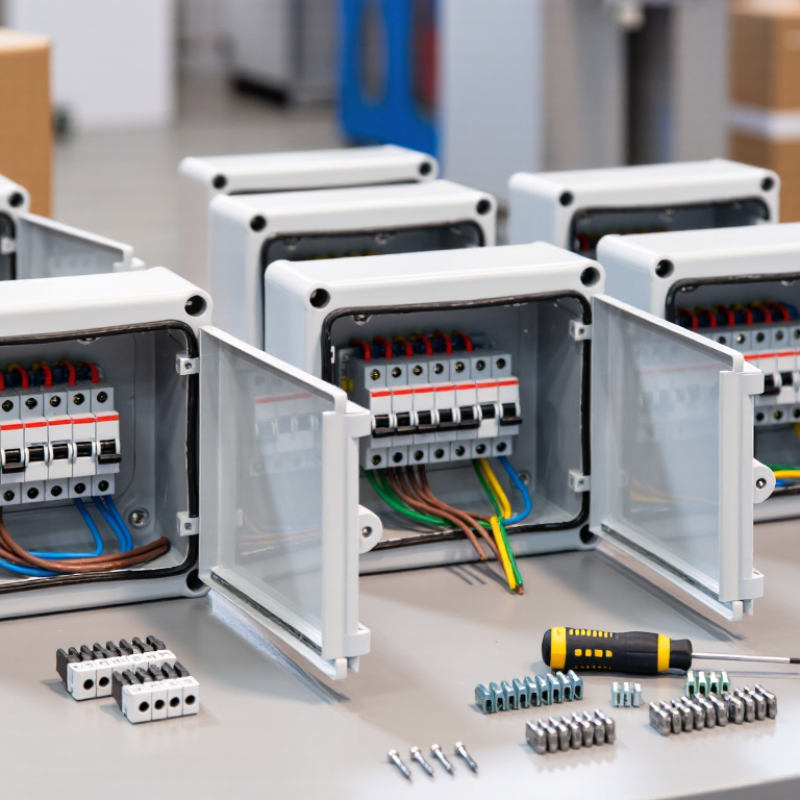
An external consumer unit is a weather-resistant enclosure for distributing and protecting electrical circuits. Inside, a DIN rail holds miniature circuit breakers, residual-current devices, or combined RCBOs. Assemblies may also include a main isolator, surge protection, and separate neutral and earth bars. The enclosure typically has a gasketed door, cable entries, and mounting points. Small details matter: a poorly sealed cable gland can undermine an otherwise robust housing. Protection ratings should match the actual exposure, including rain, dust, sunlight, and installation position.
These units commonly serve garages, garden offices, workshops, and small commercial outbuildings where circuits need local protection. The International Energy Agency’s 2023 Buildings analysis estimates that building operations account for about 30% of global final energy use, underlining the scale of electrical distribution in everyday spaces. That figure is not a consumer-unit market statistic, but it gives useful context. For buyers, compare rated current, available circuit ways, enclosure material, and clear wiring space—not just the stated IP rating. IEC 61439-3 provides a relevant framework for distribution boards operated by ordinary persons, though product suitability still depends on the specific installation. In practice, labels and drawings can be overlooked. They shouldn’t be.
External Consumer Units: Product Scope, Components, and Typical Applications
Ingress protection (IP) codes help describe an enclosure’s protection against solid objects and water. The chart compares the two digits in three standardized IP code examples; the digits are code values, not a performance score.
How to read the chart: The first IP digit represents protection against solid objects; the second represents protection against water. For example, IP65 means dust-tight protection and protection against water jets. An external consumer unit may contain an enclosure, protective devices such as circuit-breakers or RCDs/RCBOs, and neutral and earth terminals. Typical applications include outdoor circuits for gardens, outbuildings, and small commercial spaces. Select an enclosure rating to suit the installation conditions and applicable electrical regulations.
IEC 61439-3 Limits: 300 V AC, 250 A Assemblies, and 125 A Outgoing Circuits
For global buyers comparing external consumer unit manufacturers in China, IEC 61439-3:2024 offers three practical screening limits. It covers distribution boards operated by ordinary persons, with rated voltage to earth up to 300 V AC, assembly current up to 250 A, and outgoing circuits rated no higher than 125 A. These are scope limits, not proof that a particular enclosure or configuration complies.
Small numbers. Big consequences.
Ask suppliers for design-verification records under the IEC 61439 series, then check that the tested configuration matches the offered unit. Look closely at the rating label, busbar arrangement, protective devices, and cable-entry details. A neat brochure cannot show whether terminals stay within temperature limits under load. IEC 61439-1 sets the general assembly verification framework; IEC 61439-3 adds requirements for these ordinary-person distribution boards. For export projects, confirm local wiring and installation requirements separately, since IEC conformity does not automatically resolve every national deviation. I would still ask for clearer evidence when drawings and test records do not match perfectly. That gap matters.
IEC 60529 Enclosure Ratings: IP54 vs. IP65 Dust and Water Protection
For global buyers comparing external consumer units, IP54 and IP65 are not interchangeable labels. IEC 60529 defines the first digit as protection against solid particles and the second as protection against water. At IP54, “5” means dust ingress is limited, not completely prevented; “4” means protection against splashing water from any direction. IP65 raises both levels: “6” indicates a dust-tight enclosure, while “5” covers water jets.
Small difference. Big consequences.
The IEC 60529 IPX5 test specifies a 6.3 mm nozzle and a water flow of 12.5 litres per minute. That is a controlled test, not a promise of protection against every outdoor condition. Wind-driven rain, condensation, cable-entry gaps, and ageing seals still matter. For a unit installed near a washdown area, IP65 is generally the more defensible choice; for a sheltered indoor location, IP54 may be adequate. Ask manufacturers for test reports tied to the complete assembled enclosure, including doors, glands, and fasteners. A rating printed on a housing alone can be misleading. Even a sound specification needs careful installation.
Evaluating Chinese Manufacturers: ISO 9001, Type-Test Reports, and Traceability
When evaluating Chinese manufacturers of external consumer units, treat ISO 9001 as evidence of a managed quality system, not proof that every product is safe or suitable. Check that the certificate is current and covers the factory and relevant manufacturing activities. It does not replace product testing. That distinction matters.
Request type-test reports for the exact enclosure or product family under consideration. Compare model references, rated values, construction details, and test dates against the quotation and drawings. A report for a similar-looking unit may not cover changes to the door, internal layout, or materials. Look closely. For an outdoor installation, ask how the tested configuration addresses moisture and dust, and confirm the stated protection level matches your project requirements.
Traceability should connect a finished unit to its production batch and key components. Ask for sample records showing how the factory identifies enclosures, busbars, and protective devices, then follows a defect through inspection records. During a supplier review, a clear batch code on the carton and unit is a useful practical sign. Still, paperwork can look stronger than shop-floor habits. Verify a few records against real production samples, and note any gaps before placing an order.
Best External Consumer Unit Manufacturers in China for Global Buyers - Evaluating Chinese Manufacturers: ISO 9001, Type-Test Reports, and Traceability
Evidence-based buyer evaluation framework. The criteria below describe standards and records to verify; they do not rank or make unverified claims about individual manufacturers.
| Evaluation dimension | Factual benchmark | Evidence to request | Buyer verification |
|---|---|---|---|
| Quality management system | ISO 9001 certifies a quality management system within the stated certification scope. It is not, by itself, product approval or proof that a consumer unit meets an electrical product standard. | Current ISO 9001 certificate showing the legal entity, covered manufacturing site, scope, certification body, and validity dates. | Confirm the certificate’s validity and scope with the issuing certification body. Check that the listed site and activities match the factory and product being quoted. |
| Assembly design verification | IEC 61439-1 provides general rules for low-voltage switchgear and controlgear assemblies. IEC 61439-3 covers distribution boards intended to be operated by ordinary persons (DBO), within the scope and ratings set out in that standard. | Design-verification records identifying the applicable standard and edition, product construction, ratings, enclosure configuration, and verification methods. | Check that the report covers the offered external consumer unit and its actual configuration—not merely a visually similar product or a different enclosure size. |
| “Type-test” report terminology | IEC 61439 uses the term design verification. A report described commercially as a “type-test report” should still identify what was tested or assessed and how it relates to the applicable design-verification requirements. | Complete report or verifiable report extract, including report number, issue date, tested sample description, results, limitations, and laboratory details. | Match the tested sample and report scope to the current product drawings, bill of materials, ratings, and enclosure. Clarify any differences before approval. |
| Laboratory competence | ISO/IEC 17025 specifies competence requirements for testing and calibration laboratories. Accreditation applies to a defined scope of activities, not automatically to every test a laboratory performs. | Laboratory name and accreditation details, together with the relevant accreditation scope and test methods. | Check the accreditation body’s public records and confirm that the relevant test or method is included in the laboratory’s scope. |
| Ingress protection for an external unit | IEC 60529 classifies degrees of protection provided by enclosures against access to hazardous parts, ingress of solid foreign objects, and water. An IP rating relates to the tested configuration and conditions. | IP test evidence for the complete enclosure configuration, with the claimed rating, sample details, test conditions, and any installation limitations. | Confirm the rating applies to the assembled unit, including door, seals, cable entries, and other relevant openings—not just an enclosure component. |
| Impact protection, if specified | IEC 62262 defines IK ratings for the degree of protection provided by enclosures against external mechanical impacts. An IK rating should be supported by evidence for the relevant enclosure configuration. | Impact-test report stating the IK classification, test locations, sample configuration, and any conditions or exclusions. | Compare the tested configuration with the proposed product and assess whether the rating is appropriate for the intended installation environment. |
| Ratings and product identification | Assembly ratings and identification should be consistent across product markings, technical documentation, and the applicable design-verification evidence. | Nameplate or label artwork, datasheet, drawings, wiring information, and the applicable rated electrical characteristics. | Cross-check voltage, current, frequency, enclosure details, circuit arrangement, and other stated ratings against the approved configuration and destination-market requirements. |
| Routine verification | IEC 61439-1 distinguishes design verification from routine verification. Routine verification concerns each completed assembly and is not replaced by a design-verification report for a representative design. | Routine-verification procedure and completed production records for sampled or shipped units, linked to their production identifiers. | Confirm the checks are recorded for the finished assembly and that the records identify the unit or production batch concerned. |
| Production traceability | Traceability supports identification of the product and relevant production records. The precise fields and retention arrangements should be agreed for the order and destination market. | Sample serial-number or batch-code format, production and inspection records, component records, and documented record-retention arrangements. | Ask the manufacturer to demonstrate how a finished unit can be linked to its production date or batch, inspection result, and relevant material or component records. |
| Change control | Changes to enclosure materials, dimensions, seals, components, ratings, or assembly methods can affect the product configuration and the relevance of existing verification evidence. | Documented change-control process and a procedure for reviewing the impact of changes on drawings, verification evidence, and customer approvals. | Require notification and approval rules for changes that could affect safety, ratings, fit, function, or compliance with the agreed specification. |
| Destination-market documentation | Required conformity documents depend on the product, its intended use, and the destination market. A certificate or marking should not be treated as universally applicable without checking its legal basis and scope. | Applicable declarations, technical documentation, installation instructions, and market-specific conformity evidence, where required. | Confirm requirements with the relevant regulations and standards for the country of sale, and ensure documents identify the correct product and responsible economic operator where applicable. |
Global Buyer Checks: Voltage, Local Wiring Rules, CE/UKCA, and Sample Validation
For global buyers sourcing consumer units from China, voltage compatibility needs more than a quick label check. Confirm the destination’s nominal voltage, frequency, phase arrangement, and required current ratings against the proposed configuration. A 230 V marking alone may not answer every question. Check the incoming supply, protective-device choices, and terminal capacity with a qualified local electrical professional.
Local wiring rules can affect enclosure layout, circuit identification, earthing arrangements, and installation clearances. Share the intended application and destination market before production, then review drawings and wiring diagrams against local requirements. Small details matter. A clear circuit schedule and readable terminal labels can save time during installation, but they do not replace local technical review.
Treat CE or UKCA markings as part of a verification file, not as proof by themselves. Ask which requirements apply to the product and market, and review supporting declarations, test records, and traceability documents. Then inspect a physical sample. Check dimensions, cover fit, busbar alignment, terminal access, and the finish around cable entries. Where practical, arrange appropriate electrical and temperature-rise checks through a competent testing route. One sample can reveal a mismatch; it cannot guarantee every production unit will match. That deserves a second look.